Journal of Fine Arts: Architecture & Urban Planning

Journal of Fine Arts: Architecture & Urban Planning

The Journal of Fine Arts: Architecture and Urban Planning is a double-blind peer-reviewed, open access quarterly journal that covers topics and areas such as Architecture, Architectural Technology, Interior Design, Construction Management, Landscape design, Energy and buildings, Renovation and restoration of Buildings, Architectural studies of Iran and the world, Islamic Architecture, Urban Planning, Urban Design, Regional Planning, and Urban Management. Accepted papers often reflect critical and comparative analysis. The target audience includes academicians, architecture and urban planning educators, students, and architecture and planning communities at large. Submitted papers will be published after peer review and upon the approval of the editorial board. The Journal of Fine Arts was originally published in 1995 to cover all aspects of art and was divided into three journals in 2009, with the Journal of Fine Arts: Architecture and Urban Planning. Researchers may visit the site directly to register, submit, and set up their papers based on author's guidelines.

Journal Information:

• Journal Title: Fine Arts: Architecture and Urban Planning

• Country of Publication: Iran, Tehran.

• Publisher: University of Tehran Press

• Subject Area: Architecture and Urban Planning covers the following Topics and areas: Architecture, Architectural Technology, Interior Design, Construction Management, Landscape design, Energy and buildings, Renovation and restoration of Buildings, Architectural studies of Iran and the world, Islamic Architecture, Urban Planning, Urban Design, Regional Planning, Urban Management.

• Format: Print and Online

• Frequency: Quarterly

• Language: Persian, including extended English abstracts and bibliographies

• Open Access: This is a diamond open access journal (CC BY-NC 4.0.) without article processing charges (APCs), it is freely available, and is published digitally online.

• Article types: Research and review papers

• Primary Review: 15 days, approximately

• Peer Review Policy: Double-blind peer-review

• Average refereeing time: 9 weeks

• Acceptance percentage: 11%

• Citation Style: The  APA  referencing style

• Website: https://jfaup.ut.ac.ir/?lang=en

• E-mail: fineartj@ut.ac.ir

• Copyright: Authors retain unrestricted copyrights and publishing rights.

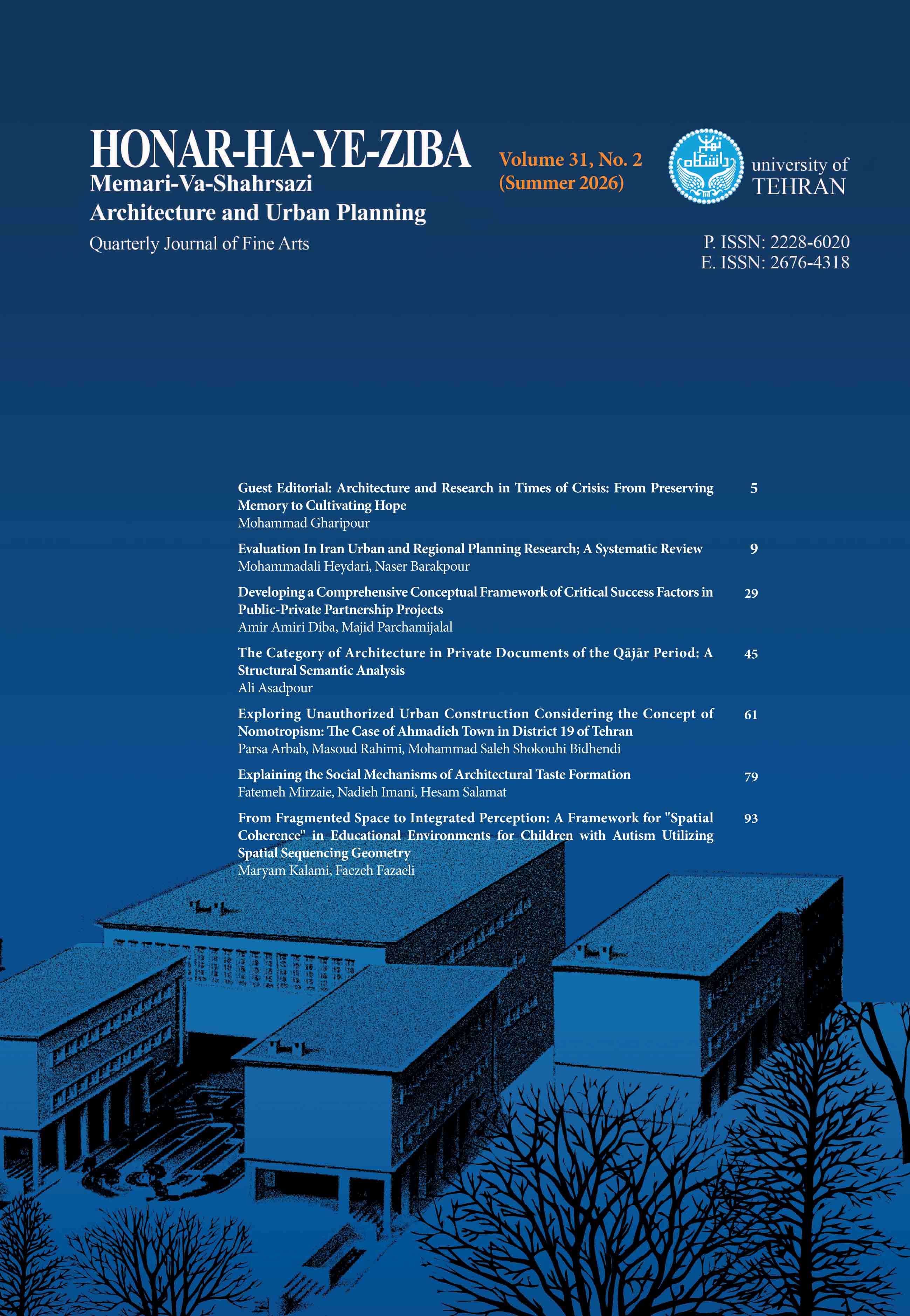
Current Issue: Volume 31, Issue 2, Summer 2026 

Indexing and Abstracting

Keywords Cloud

  • Architectural Education
  • Architecture
  • space syntax
  • Urban Planning
  • Sense of Place
  • Thermal Comfort
  • urban regeneration
  • TEHRAN
  • place attachment
  • Architectural Design
  • Housing
  • public space
  • Tehran
  • factor analysis
  • Typology
  • urban design
  • Grounded theory
  • Form
  • Space
  • House
  • nature
  • Iran
  • Energy consumption
  • time
  • participation
  • critical discourse analysis
  • design process
  • Urban form
  • Environmental psychology
  • Women
  • Built Environment
  • Spatial Organization
  • Reconstruction
  • spatial configuration
  • residential complex
  • Development
  • Iranian Architecture
  • courtyard
  • Systematic review
  • Tourism
  • urban poverty
  • Qajar
  • Planning
  • Creativity
  • Conservation
  • Traditional architecture
  • Culture
  • place
  • geometry
  • Comparative Study
  • contemporary architecture
  • Thermal performance
  • Interior Architecture
  • Urban Spaces
  • Hospital
  • Modernity
  • Sustainable architecture
  • Rasht
  • history
  • Structural Equation Modeling
  • Urban Growth
  • Adaptive Reuse
  • student dormitory
  • Neighborhood
  • power
  • Modern architecture
  • Confirmatory Factor Analysis
  • Curriculum
  • Persian Architecture
  • Tabriz
  • Analytic hierarchy process (AHP)
  • interaction
  • Tradition
  • Exploratory Factor Analysis
  • Hamedan
  • urban space
  • sustainability
  • Tehran Metropolis
  • Mosque
  • Satisfaction
  • Energy Efficiency
  • Tabriz City
  • Islamic Architecture
  • Ideation
  • Collective Memory
  • Faculty of Fine Arts
  • Sociability
  • urban sprawl
  • architecture
  • residential complexes
  • Structure
  • Spatial structure
  • Urban Management
  • Optimization
  • Utopia
  • Biomimetic
  • Home
  • Identity
  • practice
  • Urban Resilience
  • construction violations
  • Land use
  • urban expansion
  • technology
  • Public Participation
  • creative city
  • Cinema
  • factor analysis
  • Problem-Solving
  • integrated design
  • Monument
  • Environmental Stress
  • F&rsquo
  • Interior Design
  • travel behavior
  • earthquake
  • City council
  • phenomenology
  • Community
  • smart city
  • internal arrangement
  • Faculty of architecture
  • Quality assessment
  • Regionalism
  • Iranian mosque
  • metropolitan region
  • Residential satisfaction
  • Thermal comfort
  • Informal Settlements
  • Continuity
  • Integration
  • Residential building
  • Film
  • Evaluation
  • public spaces
  • perception
  • balcony
  • Health
  • Globalization
  • Landscape
  • qazvin
  • open spaces
  • Hierarchy
  • Rasht City
  • profession
  • Muqarnas
  • Sustainable urban development
  • Cultural Landscape
  • Content analysis
  • Space Creation
  • Architectural Theory
  • Tehran Municipality
  • historical documents
  • Iranian Contemporary Architecture
  • Developing Countries
  • Yazd
  • modernization
  • Historic Context
  • Safavid period
  • Constructivist Grounded Theory
  • Constitution
  • Ilkhanid period
  • Meaningful Perception
  • architecture students
  • Metropolis
  • Human
  • Interaction
  • network analysis
  • Urban Growth Patterns
  • illumination
  • ENVI-met
  • city
  • Architectural Design Process
  • design problem
  • physical changes
  • Parametric Design
  • hidden geometry
  • Schools
  • Regional competitiveness
  • Informal Settlement
  • Local Architecture
  • Meaning
  • structural equation model
  • Bojnourd
  • everyday life
  • modernism
  • Integrated Urban Management
  • environment
  • environmental security
  • Municipality
  • Industrial heritage
  • Vernacular Architecture
  • Theory
  • Daylight
  • Social capital
  • Evaluation indicators
  • Energy
  • Urban Competitiveness
  • Karbandi
  • Color